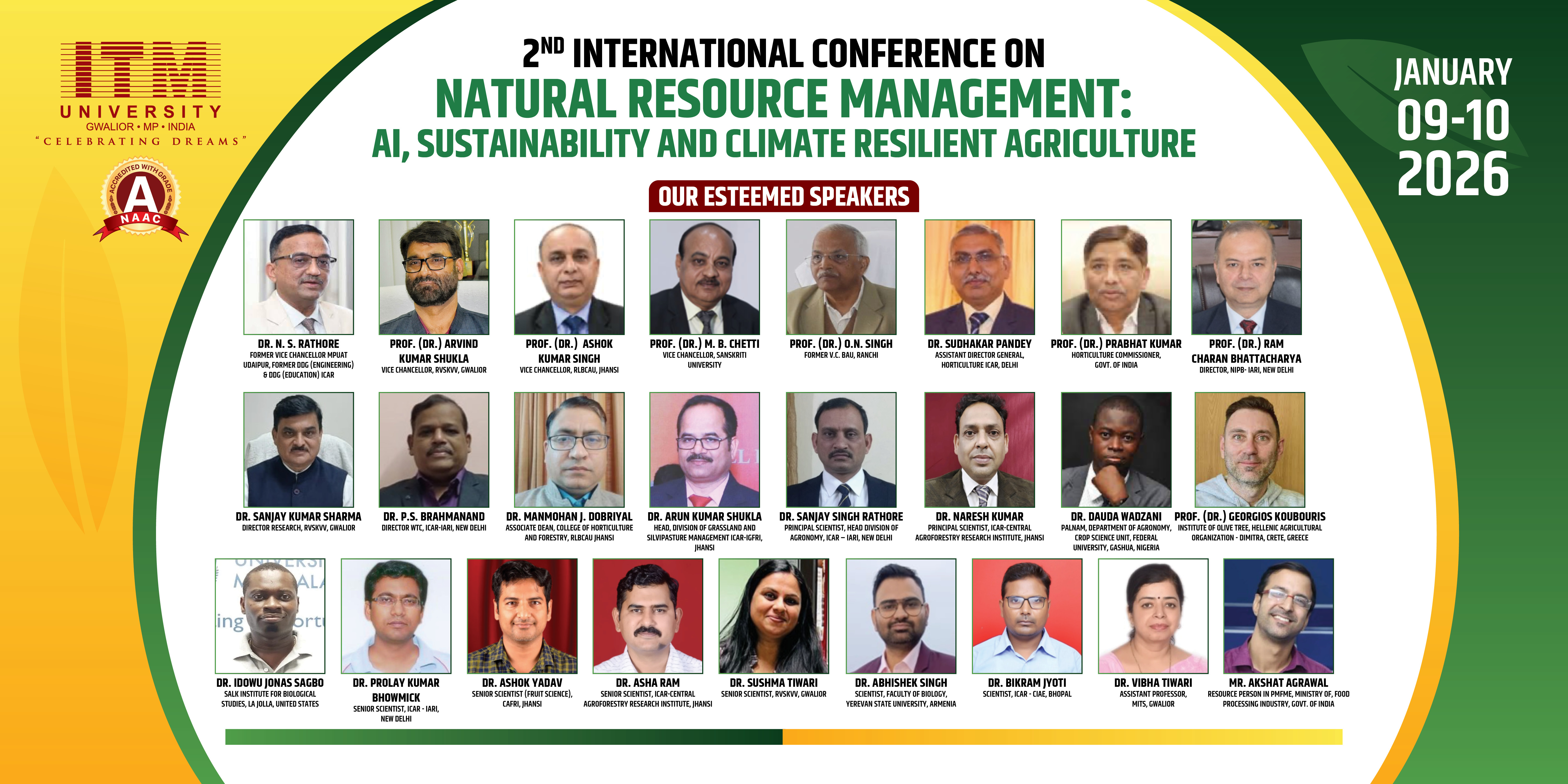
About the Conference
Agriculture worldwide stands at a critical juncture, confronted by climate change, depleting natural resources, and the growing demand for food, nutritional, and environmental security. ICNRM-2027 brings together the pillars of sustainable natural resource management, climate-smart technologies, Indian Knowledge Systems, and advanced genomics to chart a path toward resilient, productive, and equitable agricultural systems.
The conference foregrounds Agriculture 5.0, the convergence of precision farming, digital and AI-enabled technologies, next-generation crop improvement, and time-tested indigenous knowledge as the foundation for climate-resilient and globally competitive agriculture.
This conference provides a scholarly forum for academicians, scientists, policymakers, industry leaders, and students to examine how sustainable resource management, precision technologies, genomics, and Indian Knowledge Systems can jointly enable inclusive growth, ethical governance, and long-term food and environmental security.
The conference is structured in alignment with the ICAR 6th Dean's Committee recommendations, the BSMA (Bachelor of Science in Agriculture) framework, and the National Education Policy (NEP) 2020, and its themes are mapped to the United Nations Sustainable Development Goals (SDGs).
The conference will feature domain-specific technical sessions, keynote lectures by distinguished experts, a Doctoral Colloquium, poster and oral paper presentations, and a curated cultural excursion for delegates.
Keynote Speakers
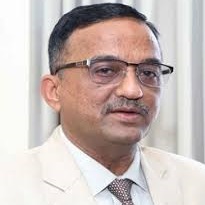
Dr. N. S. Rathore
Former Vice Chancellor MPUAT Udaipur, Former DDG (Engineering) & DDG (Education) ICAR

Dr. Sudhakar Pandey
Assistant Director General, Horticulture ICAR, Delhi
Primary Focus Areas
- Sustainable Natural Resource Management and Climate-Smart Agriculture
- Precision Agriculture, Digital Technologies, and Smart Farm
Mechanization
- Next-Generation Crop Improvement, Genomics, and Sustainable Production
Systems
- Plant Health, Food and Nutritional Security, Agribusiness, and
Entrepreneurship
- Indian Knowledge Systems, Agricultural Education, Policy, Extension, and
Rural Innovation
SDG Goals Aligned with the Conference
ICNRM-2027 supports the following United Nations Sustainable Development
Goals:
- SDG 2: Zero Hunger — Nutritional security through millets,
nutri-cereals, and next-generation crop improvement
- SDG 3: Good Health and Well-Being — Food safety and quality
- SDG 6: Clean Water and Sanitation — Water conservation and
watershed management
- SDG 8: Decent Work and Economic Growth — Agribusiness, FPOs, and
agri-startups
- SDG 9: Industry, Innovation, and Infrastructure — Precision
farming, AI, IoT, and digital agriculture
- SDG 12: Responsible Consumption and Production — Circular and
resource-use-efficient agriculture
- SDG 13: Climate Action — Climate-resilient agriculture and carbon
farming
- SDG 15: Life on Land — Biodiversity, germplasm, and ecosystem
conservation
Publication Opportunities
- Conference Proceedings (ISBN)
- Special Issues in Peer-Reviewed / Scopus/WoS/SCI/NAAS Indexed Journals
- Edited Volumes on Sustainable Agriculture and Climate-Smart Technologies
- Best Paper & Poster Awards (Sub-theme-wise)
Special Events
- Keynote Lectures by eminent scientists and academicians
- Multi-stakeholder panel discussions
- Poster and oral paper presentation sessions
- Cultural excursion for delegates
Journals Associated with the Conference
- Plant Archives (ISSN: 0972-5210, E-ISSN: 2581-6063)
- Vegetos (Springer Nature) (ISSN: 0970-4078)
- More journals are in the pipeline and will be announced soon
Publication charges, where applicable, are subject to the norms of the
respective journal / publication house.
Submission Guidelines
Abstract Submission
- Abstract of about 300 words, single-spaced
- Must include: names of authors, affiliation(s), address, objectives of
study, methodology, results, and conclusion
- Intimation of accepted abstracts within one week of submission
Full Paper Submission
- Original research papers invited for oral / poster presentation on the
sub-themes listed above
- Delegates must select their preferred mode of presentation
- Poster size: 3’ x 2’ (36” x 24”), judged by a panel of experts during
the conference
- All accepted abstracts will be published in the conference souvenir,
released at the inaugural session
Delegates are requested to strictly adhere to the submission guidelines
and ensure papers are free of plagiarism.
Important Dates
|
Activity |
Date |
| Call for Abstracts
|
To be announced
|
| Last Date for
Abstract Submission |
To be announced
|
| Notification of
Abstract Acceptance |
To be announced
|
| Last Date for Full
Paper Submission |
To be announced
|
| Notification of
Acceptance / Revision |
To be announced
|
| Last Date for
Registration |
To be announced
|
| Conference Dates
|
4 & 5 Feb. 2027
|
Dates will be finalised and published by the organizing committee closer
to the conference.
Registration Fees
Indicative registration fee structure (in line with prior School of
Agriculture, ITMU conferences), to be confirmed by the organizing committee:
|
S. No. |
Category |
Online (INR) |
Offline (INR) |
|
1 |
Students (UG) |
1,000 |
1,200 |
|
2 |
PG Students |
1,200 |
1,500 |
|
3 |
Ph.D. Scholars |
1,500 |
1,800 |
|
4 |
Faculty / Scientist
/ SRF / RA |
2,000 |
2,500 |
|
5 |
Industry Person
|
3,000 |
5,000 |
|
6 |
Foreign
Participants |
5,000 (approx. $60) |
5,000 |
|
7 |
Foreign
Participants (SAARC Countries) |
3,500 |
3,500 |
Registration fee includes: registration kit, conference guidelines,
access to scientific sessions and exhibition, and session-break
refreshments. Final fee structure to be confirmed by the organizing
committee.
Conference Tracks & Academic Sessions
Sub-Theme I: Sustainable Natural Resource Management and Climate-Smart
Agriculture
- Soil, water, and biodiversity conservation
- Climate-resilient agriculture and carbon farming
- Watershed management and ecosystem restoration
- Conservation agriculture and regenerative farming
- Organic, natural, and integrated farming systems
- Circular agriculture and resource-use efficiency
Sub-Theme II: Precision Agriculture, Digital Technologies, and Smart Farm
Mechanization
- Precision farming and digital agriculture
- Artificial Intelligence (AI), Machine Learning (ML), and Big Data
Analytics
- Internet of Things (IoT), Remote Sensing, GIS, UAVs, and Robotics
- Smart irrigation, sensors, automation, and decision support systems
- Agricultural engineering, renewable energy, and smart farm mechanization
Sub-Theme III: Next-Generation Crop Improvement, Genomics, and
Sustainable Production Systems
- Plant breeding and genetics
- Next-Generation Sequencing (NGS), molecular breeding, and genomic
selection
- Genome editing (CRISPR), functional genomics, and bioinformatics
- Germplasm conservation and genetic resource management
- Seed science and technology
- Agronomy, horticulture, agroforestry, protected cultivation, and
climate-resilient cropping systems
Sub-Theme IV: Plant Health, Food and Nutritional Security, Agribusiness,
and Entrepreneurship
- Soil health, plant pathology, entomology, nematology, and weed
management
- Integrated pest and disease management
- Millets and nutri-cereals for nutritional security
- Food processing, post-harvest technology, food safety, and value
addition
- Agricultural economics, agribusiness management, FPOs, agri-startups,
and digital value chains
Sub-Theme V: Indian Knowledge Systems, Agricultural Education, Policy,
Extension, and Rural Innovation
- Indian Knowledge Systems (IKS) and Vedic agriculture
- Indigenous technical knowledge and natural farming
- Agricultural extension and rural development
- Experiential learning, skill development, and entrepreneurship (ICAR 6th
Dean's Committee & NEP 2020)
- Agricultural policy, One Health, SDGs, and climate governance
- Women and youth empowerment, academia–industry–farmer partnerships, and
sustainable rural livelihoods
About the School of Agriculture, ITM University Gwalior
ITM University was established in 2011 and, in a relatively short time, has
gained significant recognition for its impressive growth, emerging as one of
the leading private universities in the country. It offers undergraduate,
postgraduate, and Ph.D. programs across Engineering and Technology,
Management, and Agriculture, among other disciplines, supported by strong
industry partnerships and a well-qualified, experienced faculty.
The School of Agriculture was established in 2013 to offer a four-year B.Sc.
(Hons.) Agriculture and M.Sc. programs in Vegetable Science, Genetics and
Plant Breeding, and Agronomy, addressing the growing demand for skilled
talent in the field. The curriculum emphasizes quality education, practical
exposure, and project-based learning, aligning with the guidelines set by
the ICAR 6th Dean's Committee and BSMA framework. It includes hands-on
training, experiential learning, skill development, rural agricultural work
experience, in-plant industry training, and student projects as part of the
Student READY Programme.
ITM University Gwalior is graded 'A' by NAAC and is recognized by statutory
bodies including ICAR, AICTE, INC, COA, and NCTE. The university maintains
international academic collaborations, including with the University of
Greenwich, London, and Staffordshire University, and has received more than
42 national and international awards and recognitions.
Organizing Committee
Chief Patron
Smt. Ruchi Singh Chauhan
Chancellor
ITM University Gwalior
Dr. Daulat Singh Chauhan
Pro-Chancellor
ITM University Gwalior
Patron
Prof. (Dr.) Yogesh Upadhyay
Vice Chancellor
ITM University Gwalior
Dr. Omveer Singh
Registrar
ITM University Gwalior
Academic Patron
Prof. (Dr.) Ranjit Singh Tomar
Dean Academics-I
ITM University Gwalior
Prof. (Dr.) Sonia Johri
Dean Academics-II
ITM University Gwalior
Prof. (Dr.) Pallavi Khatri
Dean Research
ITM University Gwalior
Prof. (Dr.) Shyam Akashe
Dean – International Cooperation & Projects
ITMU
Convener
Dr. Shama Parveen
Dean, School of Agriculture
ITMU
Chairman
Prof. (Dr.) Jaidev Sharma
Head, Agronomy, School of Agriculture
ITMU
Co-Chairman
Prof. (Dr.) S. K. Bhatnagar
Founder Chairman, Society for Plant Research (SPR)
& Editor-in-Chief, VEGETOS
Prof. (Dr.) R. S. Yadav
Editor-in-Chief, Plant Archives
Organizing Secretary
Dr. Sudheer K. Pathak
Assistant Professor, School of Agriculture
ITMU
Dr. A. P. Mahanta Sharma
Assistant Professor, School of Agriculture
ITMU
Dr. Shipra Singh Parmar
Assistant Professor, School of Agriculture
ITMU
Dr. Ravi Shinde
Assistant Professor, School of Agriculture
ITMU
Treasurer
Dr. Paras Nath Jhariya
Assistant Professor, School of Agriculture
ITMU
Venue & Contact
Venue: ITM University Gwalior, NH-44, Turari, Gwalior (M.P.) – 474001, India.
For further details, contact:
-
Dr. Sudheer K. Pathak (Organizing Secretary), Assistant Professor, SoAg, ITM University Gwalior — Contact: +91 9473538142
-
Dr. A. P. Mahanta Sharma (Organizing Secretary), Assistant Professor, SoAg, ITM University Gwalior — Contact: +91 7005165655
-
Dr. Ranjith Reddy, Assistant Professor, SoAg, ITM University Gwalior — Contact: +91 8349150668
-
Dr. Vipin Kumar, Assistant Professor, SoAg, ITM University Gwalior — Contact: +91 9410234513
Email and online registration link for ICNRM-2027 will be announced by the organizing committee (indicatively following the pattern icnrm.soag@itmuniversity.ac.in, similar to prior School of Agriculture conferences).

 Leadership
 Recognitions
  What Gwalior Offers
 Infrastructure
 Eligibility Criteria
 Fee Structure (2025-26)
 Scholarship Policy
 Ph.D. Notifications

.png)