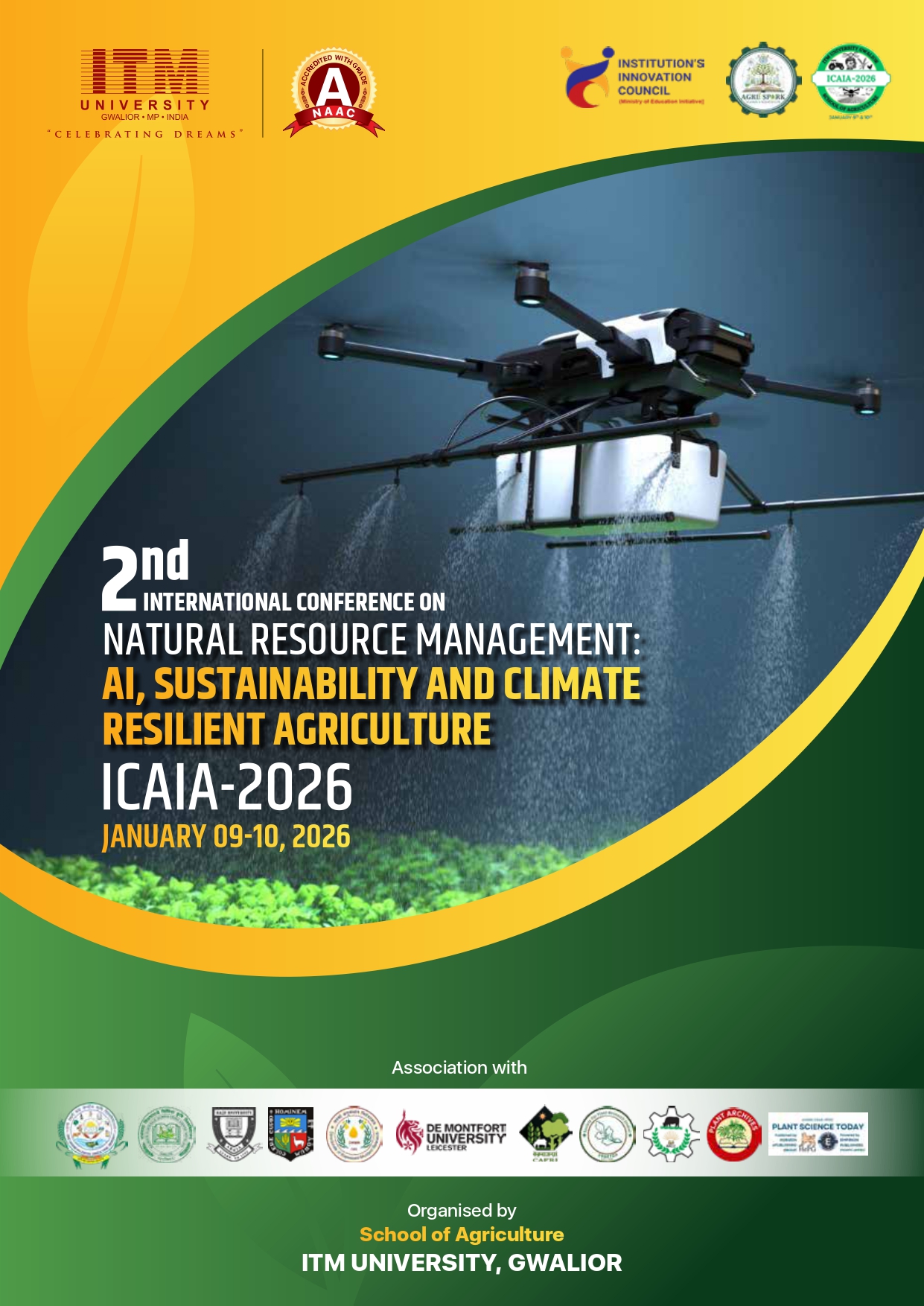
ITM University Gwalior is ranked among the best as Platinum Category Engineering Institute in India by AICTE, Ministry of HRD, Govt. of India in 2017.
T: 1800 270 0031
Email: admissions@itmuniversity.ac.in
ITM University
NH-44,BypassTurari, Jhansi Road Gwl (M.P.) 475001,(INDIA)
Recent advances in AI—combining machine learning, remote sensing, geospatial analytics, and IoT-based decision systems—are transforming natural resource management and precision agriculture. AI-enabled tools support efficient soil, water, and nutrient management, climate and yield forecasting, and early detection of crop stress, pests, and diseases. These applications improve resource-use efficiency, reduce environmental externalities, and strengthen climate resilience, thereby contributing to sustainable intensification and adaptive agricultural systems.
Beyond production, AI is enhancing post-harvest management, supply-chain transparency, and market intelligence, helping reduce food loss and waste while improving traceability and food safety. Such system level efficiencies promote responsible consumption and production and support climate-smart agri-food systems. However, realizing the full potential of AI requires addressing persistent challenges related to digital infrastructure, data accessibility, affordability, and capacity building— particularly for smallholder farmers who are central to inclusive and sustainable agricultural transformation.
ICAIA-2026 provides an interdisciplinary platform for researchers, policymakers, practitioners, and industry stakeholders to critically examine how AI can accelerate progress toward sustainability-oriented development goals through improved natural resource governance and climate-resilient agriculture. The conference seeks to foster evidence-based dialogue and collaborative solutions that integrate technological innovation with ecological stewardship and social equity.
The School of Agriculture, ITM University, established in 2013, has emerged as a centre of excellence in agricultural education, research, and experiential learning, and is a pioneer in integrating Artificial Intelligence (AI) into agricultural education and practice. The School offers B.Sc. (Hons.) Agriculture, B.Tech. (Agriculture), and postgraduate programs in Vegetable Science, Genetics and Plant Breeding, and Agronomy, designed to address contemporary challenges in agriculture and natural resource management.
The School is supported by extensive instructional and research farms, advanced discipline-specific laboratories, and modern digital infrastructure that enable hands-on training, precision agriculture, and AI-enabled field experimentation. Pedagogy is strongly anchored in experiential and outcome-based learning, integrating Experiential Learning Programmes (ELPs), Rural Agricultural Work Experience (RAWE), in-plant industry training, and project-based learning, in accordance with the Fifth and Sixth Deans’ Committees and the BSMA Committee of ICAR under the Student READY Programme.
Faculty members actively pursue innovative and interdisciplinary research in areas such as AI-driven precision farming, climate resilient crop systems, sustainable natural resource management, smart irrigation, crop modeling, digital phenotyping, and agri decision support systems, contributing to high-quality publications and translational outcomes. Strong linkages with industry, research organizations, and agri-enterprises foster entrepreneurship, start up incubation, and placements, preparing graduates for careers in agribusiness, research, extension, and technology-enabled agriculture.
ITM University, Gwalior is a multidisciplinary university established in May 2011 under an Act of the State Legislature and recognized under Section 2(f) of the UGC Act. The University is accredited with ‘A’ Grade by NAAC, reflecting its strong commitment to academic excellence, research quality, and institutional governance.
The University has earned a strong national and international reputation for the quality of its teaching, research, and innovation ecosystem across diverse disciplines. With more than forty prestigious awards and recognitions, ITM University consistently features among leading institutions evaluated by government and independent bodies.
ITM University offers a wide spectrum of undergraduate, postgraduate, and doctoral programs spanning agriculture, engineering, management, pharmacy, commerce, architecture, computer applications, physical education, sciences, nursing, and allied domains. The University maintains a dynamic academic environment that integrates teaching, research, skill development, and societal engagement.
At the academic front, ITM University actively pursues collaborative programs with reputed international universities, including institutions in the United Kingdom, and continues to expand its global academic network. The University remains at the forefront of learning, research, and innovation, fostering interdisciplinary scholarship and preparing learners to address complex global challenges.
Smt. Ruchi Singh Chauhan, Chancellor, ITM University Gwalior
Dr. Daulat Singh Chauhan, Pro- Chancellor, ITM University Gwalior
Prof. (Dr.) Yogesh Upadhyay, Vice Chancellor, ITM University Gwalior
Dr. Omveer Singh, Registrar, ITM University Gwalior
Prof. (Dr.) Ranjit Singh Tomar, Dean Academics I
Prof. (Dr.) Sonia Johri, Dean Academics II
Prof. (Dr.) Satish Kumar SharmaDean, School of Agriculture, ITMU
Prof. (Dr.) Shyam AkasheDean-International Cooperation & Projects, ITMU
Dr. Shama Parveen, Associate Professor & Head, School of Agriculture, ITMU
Original research papers on the above-mentioned sub- themes are invited for oral /poster presentation. The delegates are required to submit the abstract on mail: icaiapublication.soag@itmuniversity.ac.in
An abstract of 300 words with the name of authors, address, objectives of study, methodology, results and conclusion in single space should be submitted before the deadline. Intimation of the accepted abstracts will be done within one week of abstract submission.
Original research papers on the above- mentioned sub-themes are invited for oral/ poster presentation. The delegates are required to select their choice of paper presentation.
The poster should be in one piece and systematically arranged in the size of 3’ x 2’ (36” x 24”). The poster sessions will be judged by a panel of experts during second day (before noon) of the conference.
| S. No. | Participants | Online Amount | Offline Amount |
|---|---|---|---|
| 1 | Students (UG) | Rs. 1000 | Rs. 1200 |
| 2 | PG Students | Rs. 1200 | Rs. 1500 |
| 3 | Ph.D. Scholar | Rs. 1500 | Rs. 1800 |
| 4 | Faculty / Scientist / SRF / RA | Rs. 2000 | Rs. 2500 |
| 5 | Industry Person | Rs. 3000 | Rs. 5000 |
| 6 | Foreign Participants | Rs. 5000 | Rs. 5000 |
| 7 | Foreign Participants (SAARC Countries) | Rs. 3500 | Rs. 3500 |