ITM University Gwalior is ranked among the best as Platinum Category Engineering Institute in India by AICTE, Ministry of HRD, Govt. of India in 2017.
T: 1800 270 0031
Email: admissions@itmuniversity.ac.in
ITM University
NH-44,BypassTurari, Jhansi Road Gwl (M.P.) 475001,(INDIA)
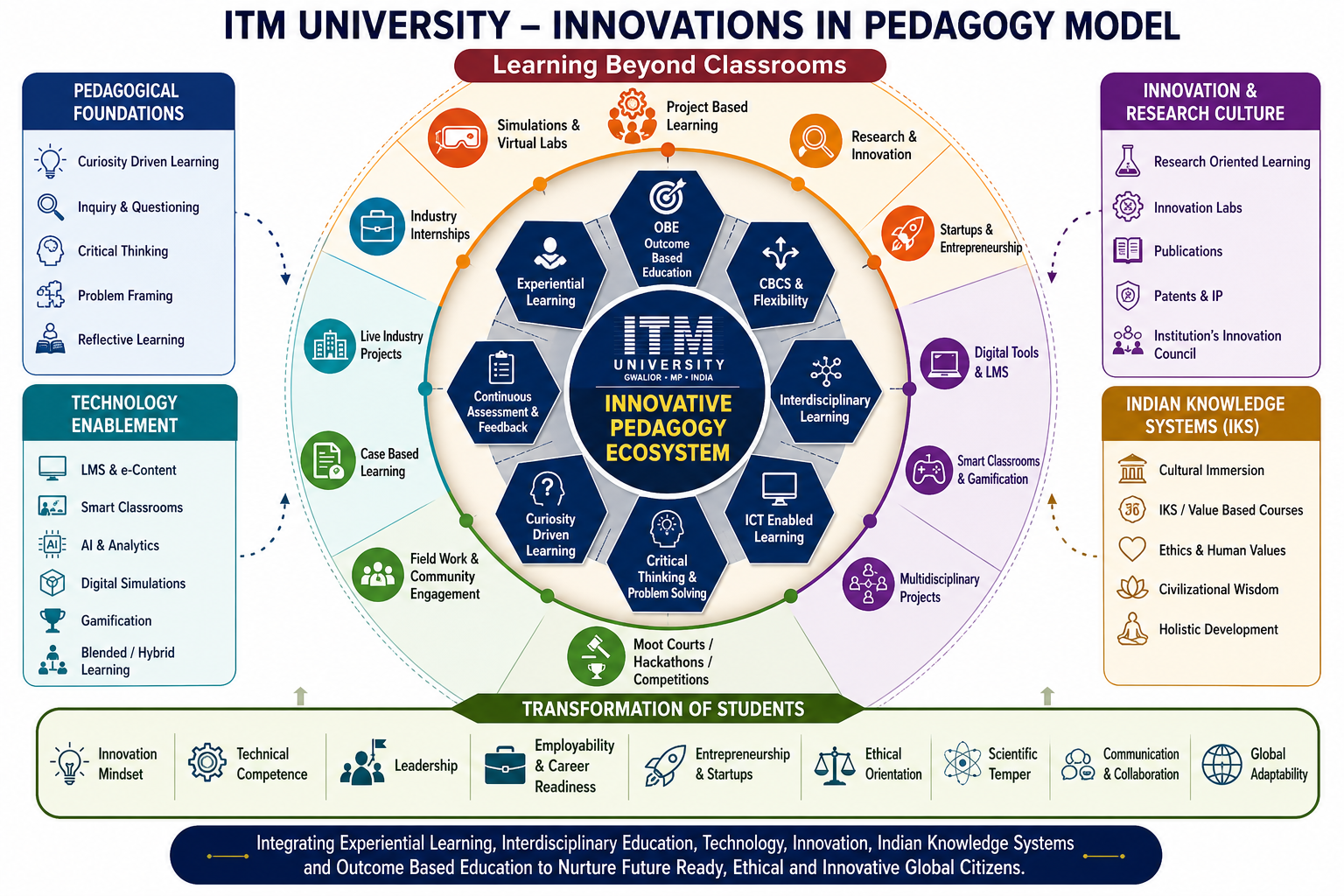
ITM University stands out for its commitment to fostering well-rounded graduates prepared to thrive in the real world. This dedication is evident in their unique educational approach, which goes beyond traditional lectures and textbooks. ITM University embraces a philosophy of experiential learning, where students actively engage with the material through a variety of hands-on methods.
This approach incorporates activity-based assessments, challenging students to demonstrate their knowledge not just through exams but also through projects, research papers, and presentations. The curriculum may also leverage case studies, immersing students in real-world scenarios relevant to their chosen field. Furthermore, fieldwork and industrial visits provide invaluable opportunities to observe practical applications of theoretical concepts and connect with professionals in the industry.
Through these experiential learning methods, ITM University fosters a dynamic learning environment that cultivates critical thinking, problem-solving skills, and a deep understanding of the chosen subject matter. This combination of theoretical knowledge and practical experience prepares graduates for success in their chosen careers and equips them to confidently navigate the complexities of the professional world.
Activity-Based Continuous Assessment (ABCA) is a forward-thinking educational method that focuses on embedding regular, hands-on activities into the curriculum to continually evaluate and enhance student learning. Departing from traditional assessment techniques that heavily rely on periodic exams and tests, ABCA emphasizes the ongoing evaluation of students’ understanding and skills through continuous activities and projects. This approach promotes active learning, cultivates critical thinking, and facilitates the practical application of theoretical knowledge, ensuring students remain engaged and consistently develop their competencies. At ITM University in Gwalior, it is a requirement that 50% of the internal assessment component is conducted using ABCA.
The primary objectives of implementing ABCA at ITM University, Gwalior, are to:
ABCA at ITM University consists of several key components:
To effectively implement ABCA, ITM University employs the following strategies:
The use of ABCA at ITM University offers several advantages:
ABCA is implemented across various disciplines at ITM University, each tailored to the specific needs and learning outcomes of the field:
By integrating ABCA into diverse disciplines, ITM University, Gwalior, ensures that students receive a well-rounded education that equips them with the knowledge, skills, and practical experience needed for their future careers.
Case studies are a powerful pedagogy in higher education that challenge students to analyze complex, real-world scenarios. By delving into these situations, students develop critical thinking, decision-making, and problem-solving skills while applying theoretical knowledge to practical situations.
Clinical practice as a pedagogy in higher education refers to a hands-on learning approach where students engage in real-world experiences within clinical settings. It is widely used in disciplines such as medicine, nursing, psychology, and allied health sciences to build practical skills, professional competence, and ethical awareness.
Corporate training as a pedagogy integrates professional industry training into academic programs. By collaborating with corporate partners, institutions enhance student learning through practical exposure, real-world projects, and industry-relevant skills, preparing graduates for successful careers.
Corporate training as a pedagogy offers a dynamic and practical learning approach that bridges the gap between academia and industry. By integrating professional training into academic programs, institutions equip students with essential skills, industry exposure, and networking opportunities, preparing them to thrive in the modern workforce while fostering innovation and collaboration.
Cultural immersion as a pedagogy in higher education provides students with experiential learning opportunities in diverse cultural settings. This approach enhances cross-cultural understanding, global awareness, and communication skills by exposing students to authentic traditions, languages, and lifestyles.
Cultural immersion offers a transformative educational experience that prepares students to thrive in a multicultural and interconnected world. By engaging in diverse cultural environments, students develop empathy, adaptability, and a strong sense of global citizenship, making them well-equipped for future personal and professional challenges.
Design thinking is a human-centered problem-solving approach that emphasizes empathy, creativity, and iterative innovation. It enables students to tackle complex real-world challenges by focusing on user needs and developing practical, innovative solutions.
Design thinking transforms the learning experience by encouraging innovation, empathy, and collaboration. It equips students with essential skills to solve complex problems, adapt to change, and contribute meaningfully to society as creative thinkers and innovators.
Entrepreneurship projects are dynamic learning experiences that challenge students to develop and implement innovative ideas in real or simulated business environments. This approach nurtures creativity, critical thinking, and problem-solving skills while preparing students for entrepreneurial and professional success.
Entrepreneurship projects create a dynamic and engaging learning environment that fosters innovation, resilience, and real-world problem-solving. By encouraging students to think entrepreneurially, institutions empower them to become adaptable, creative professionals capable of thriving in an ever-changing global landscape.
Experiential Learning Programme (ELP) is a dynamic pedagogical approach that emphasizes learning through active participation, hands-on experience, and reflection. Rooted in the philosophy of “learning by doing,” ELP enables students to gain practical exposure and develop essential professional competencies.
In business and allied disciplines, ELP enhances skills in project planning, decision-making, teamwork, problem-solving, accounting, marketing, and quality control through real-world engagement.
The Experiential Learning Programme was introduced by the Indian Council of Agricultural Research (ICAR) under the “Students READY (Rural Entrepreneurship Awareness Development Yojana)” initiative. It is widely implemented in disciplines such as agriculture, horticulture, fisheries, veterinary sciences, and allied fields.
Typically conducted during the penultimate semester of undergraduate programs, ELP aims to prepare students to become job creators rather than job seekers by fostering an entrepreneurial mindset and practical expertise.
Experiential Learning Programmes provide a transformative educational experience by integrating theory with practice. Through real-world engagement, ELP equips students with practical skills, entrepreneurial thinking, and professional confidence, preparing them to excel in their careers and contribute meaningfully to society.
Experiential Outdoor Education (EOE) is an innovative pedagogy that uses the natural environment as a classroom to promote active learning and personal growth. Through hands-on outdoor activities and reflective practices, students develop deeper insights into themselves, their surroundings, and academic concepts.
Experiential Outdoor Education offers transformative learning experiences that extend beyond the classroom. By engaging with nature, students develop essential life skills, deepen their understanding of academic content, and build a strong connection with the environment, preparing them for personal and professional success.
Fieldwork is a powerful pedagogy that immerses students in real-world environments beyond the classroom. Through hands-on research, observation, and data collection, students gain practical experience, deepen their understanding of academic concepts, and build a strong connection with real-world contexts.
Fieldwork enriches higher education by extending learning beyond the classroom. It equips students with practical skills, research capabilities, and a deeper appreciation of real-world complexities, preparing them to contribute effectively to their chosen fields and society.
Policy on Teaching and Learning • ITM University, Gwalior
The flipped classroom model reverses traditional teaching by delivering instructional content outside the classroom and using class time for interactive, practical learning. Students engage with lectures, videos, and readings before class, allowing in-class sessions to focus on discussions, problem-solving, and collaborative activities.
This approach promotes active learning, encourages student responsibility, and enhances understanding through application-based learning.
The flipped classroom model creates an engaging and student-centered learning environment by shifting the focus from passive listening to active participation. By integrating this approach, ITM University, Gwalior enhances learning outcomes and equips students with the skills needed for academic and professional success.
Gamification integrates game elements and design principles into educational practices to make learning more engaging, interactive, and effective. By introducing elements like rewards, challenges, and storytelling, it transforms traditional learning into an enjoyable and motivating experience.
Gamification transforms traditional learning into an engaging and interactive experience. By thoughtfully integrating game elements, educators can enhance motivation, deepen understanding, and create a dynamic learning environment that prepares students for real-world challenges.
Industrial visits are a vital pedagogical approach that connects classroom learning with real-world industry practices. By immersing students in live industrial environments, these visits provide practical exposure, helping them understand how theoretical concepts are applied in professional settings.
Industrial visits enrich academic learning by offering real-world exposure and practical insights. They prepare students for professional environments, enhance their skillsets, and foster a deeper understanding of their chosen disciplines, making them industry-ready and confident professionals.
Bridging the Gap Between Theory and Practice
Internships and Work-Based Learning (WBL) are essential pedagogical approaches that integrate academic learning with real-world professional experience. These experiences enable students to apply classroom knowledge in practical settings, develop industry-relevant skills, and enhance their career readiness.
Internships and work-based learning experiences play a vital role in preparing students for the professional world. By combining academic knowledge with practical exposure, they equip students with the skills, confidence, and networks needed to succeed in their careers.
Competitive Spirit Meets Learning
Participation in academic competitions provides a dynamic learning experience beyond the classroom. It enables students to apply knowledge in competitive environments, develop essential skills, and gain valuable exposure that enhances academic and professional growth.
Participation in competitions enriches the educational journey by fostering innovation, resilience, and practical skills. It prepares students to excel in real-world challenges and builds a strong foundation for future academic and professional success.
Cultivating Critical Thinkers and Problem-Solvers
Problem-Based Learning (PBL) is a student-centered pedagogy that uses open-ended, real-world problems as the foundation for learning. It encourages active engagement, collaboration, and self-directed inquiry, helping students develop critical thinking, problem-solving, and lifelong learning skills.
Problem-Based Learning transforms education into an active, engaging process where students tackle real-world challenges. By fostering critical thinking, collaboration, and independent learning, PBL prepares students to thrive in dynamic professional environments and become lifelong learners.
Cultivating Active Learners
Project-Based Learning (PjBL) is an engaging pedagogical approach that involves students in extended projects culminating in a final product or presentation. It moves beyond passive learning, enabling students to apply knowledge and skills to solve real-world problems and answer complex questions.
Project-Based Learning empowers students to become active learners by engaging them in meaningful, real-world projects. It nurtures essential skills such as critical thinking, collaboration, and creativity, preparing students to succeed in academic, professional, and real-life environments.
Stepping into Different Shoes for Deeper Learning
Role-playing is an engaging pedagogy in higher education that allows students to assume different roles and participate in simulated scenarios. This active learning approach promotes critical thinking, communication, and empathy by encouraging students to explore multiple perspectives and real-world situations.
Role-playing transforms traditional learning into an interactive experience, allowing students to explore diverse perspectives and real-world challenges. By fostering empathy, communication, and critical thinking, it prepares students for professional and social interactions in a dynamic world.
Cultivating Knowledge Through Experiential Learning
Rural Agricultural Work Experience (RAWE) is an experiential learning approach designed to provide students with hands-on exposure to rural agricultural practices, community engagement, and sustainable development. It connects academic learning with real-world agricultural environments, fostering practical skills and rural awareness.
RAWE is a transformative educational approach that bridges the gap between academic learning and rural realities. By fostering practical skills, community engagement, and entrepreneurial thinking, it prepares students to contribute meaningfully to agricultural development, rural sustainability, and national growth.
Bridging the Gap Between Theory and Action
Service-learning is a powerful pedagogy that combines academic learning with meaningful community service. Students participate in real-world projects that address community needs, allowing them to apply their knowledge and skills while developing a deeper understanding of course content and civic responsibility.
Service-learning offers a transformative educational experience that benefits both students and communities. By integrating academic learning with meaningful service, it empowers students to become engaged citizens, lifelong learners, and agents of positive change.
Engaging Learners in Realistic Scenarios
Simulations are a powerful pedagogy in higher education that use technology or role-playing to create realistic scenarios where students can practice skills, apply knowledge, and make decisions in a safe and controlled environment. This enables learners to experiment and learn from mistakes without real-world consequences.
Simulations provide an engaging and dynamic learning experience beyond traditional lectures. By integrating simulations effectively, educators can create immersive environments that help students develop essential professional skills such as critical thinking, problem-solving, and decision-making.
Bridging the Gap with Simulated Learning Environments
Virtual labs are transforming pedagogy in higher education by offering immersive, accessible, and safe simulated learning environments. These web-based platforms allow students to conduct experiments, practice procedures, and analyze data remotely, overcoming the limitations of traditional physical laboratories.
Virtual labs are redefining modern education by bridging the gap between theory and practice. They create safe, flexible, and engaging environments where students can experiment, learn, and innovate. By integrating virtual labs with other pedagogical approaches, institutions can foster deeper understanding, skill development, and lifelong learning.